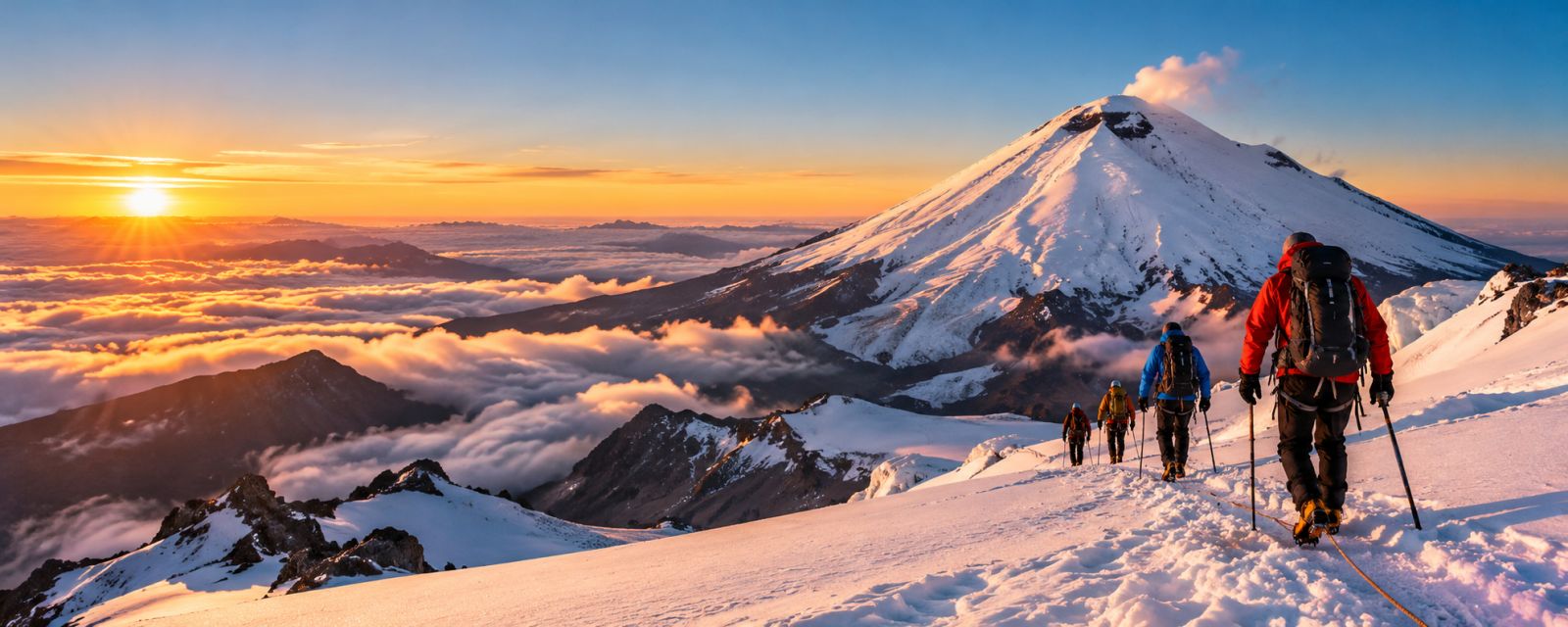
Why a 16-Day Ecuador Mountaineering Program Can Be Better Than a 7-Day Trip
Why a 16-Day Ecuador Mountaineering Program Can Be Better Than a 7-Day Trip
Planning a mountaineering expedition in Ecuador? Choosing between a 7-day climbing trip and a 16-day mountaineering program can make a significant difference in your experience, preparation, and opportunities to explore the Andes.
Ecuador is one of South America's most remarkable mountaineering destinations, home to spectacular volcanoes, glacier-covered summits, and challenging high-altitude climbing routes.
From the iconic Cotopaxi Volcano to the towering Chimborazo and the impressive glaciers of Cayambe, Ecuador offers unforgettable adventures for climbers from around the world.
But when planning your Ecuador climbing expedition, an important question arises:Is a 7-day mountaineering trip enough, or is a 16-day Ecuador mountaineering program a better choice?
The answer depends on your climbing goals, previous experience, available time, and acclimatization needs.
For many international climbers, especially those arriving from lower elevations, a longer itinerary offers important advantages.
In this guide, Ecuadorian Alpine Institute explores the differences between 7-day and 16-day Ecuador climbing expeditions and explains why additional time can make your Andean adventure more rewarding.
Why Ecuador Is a World-Class Mountaineering Destination
Located along the equator in northwestern South America, Ecuador is home to some of the most impressive volcanic mountains in the Andes.
Despite its relatively small geographical size, the country offers exceptional opportunities for high-altitude hiking, glacier training, and challenging mountaineering expeditions.
Some of Ecuador's most famous climbing destinations include:
- Cotopaxi Volcano (5,897 m / 19,347 ft): One of the world's most recognizable volcanoes, famous for its snow-covered summit and glaciated climbing terrain.
- Chimborazo Volcano (6,263 m / 20,548 ft): Ecuador's highest mountain and the point on Earth's surface farthest from its center.
- Cayambe Volcano (5,790 m / 18,996 ft): A spectacular glacier-covered mountain located near the equator.
- Iliniza Norte (5,126 m / 16,818 ft): A popular high-altitude mountaineering objective often included in acclimatization programs.
- Rucu Pichincha (4,696 m / 15,407 ft): A well-known mountain near Quito that offers opportunities for high-altitude hiking.
These mountains make Ecuador an attractive destination for climbers seeking to develop their skills, gain altitude experience, and attempt significant Andean summits.
However, reaching high elevations requires careful planning.
That is where the duration of your mountaineering itinerary becomes especially important.
7-Day vs. 16-Day Ecuador Mountaineering Programs: What's the Difference?
Both short and extended climbing expeditions can offer memorable experiences in Ecuador.
However, they are designed for different objectives and types of climbers.
A 7-day Ecuador climbing tour generally focuses on a limited number of mountains and activities.
A 16-day Ecuador mountaineering expedition can provide more opportunities for gradual acclimatization, technical preparation, recovery, and multiple climbing objectives.
Ecuador Mountaineering Program Comparison
Feature: Trip duration
a) 7-Day Climbing Trip: 7 days
b) 16-Day Mountaineering Program: 16 days
Feature: Acclimatization
a) 7-Day Climbing Trip: Limited by the shorter schedule
b) 16-Day Mountaineering Program: More time for progressive altitude adaptation
Feature: Mountain objectives
a) 7-Day Climbing Trip: Usually one primary summit or a limited selection
b) 16-Day Mountaineering Program: Potential for several progressive climbing objectives
Feature: Glacier training
a) 7-Day Climbing Trip: May be limited
b) 16-Day Mountaineering Program: More flexibility for technical training
Feature: Recovery time
a) 7-Day Climbing Trip: Less flexibility
b) 16-Day Mountaineering Program: More opportunities for rest and recovery
Feature: Weather flexibility
a) 7-Day Climbing Trip: Limited
b) 16-Day Mountaineering Program: Greater scheduling flexibility
Feature: Cultural experiences
a) 7-Day Climbing Trip: Usually fewer
b) 16-Day Mountaineering Program: More opportunities to explore Ecuador
Feature: Ideal traveler
a) 7-Day Climbing Trip: Time-limited or previously acclimatized climbers
b) 16-Day Mountaineering Program: Climbers seeking a more comprehensive expedition
These are general comparisons. The actual advantages depend on the itinerary, sleeping elevations, mountain conditions, and individual climber readiness.
The biggest advantage of a longer mountaineering program is not simply having more days. It is having more opportunities to prepare appropriately for demanding high-altitude objectives.
1. More Time for Proper High-Altitude Acclimatization
One of the most important reasons to consider a 16-day Ecuador mountaineering program is altitude acclimatization.
As climbers ascend to higher elevations, atmospheric pressure decreases, reducing the oxygen available to the body.
Without adequate acclimatization, climbers may experience altitude-related symptoms such as headaches, nausea, dizziness, unusual fatigue, and sleep disturbances.
More serious altitude illnesses can become life-threatening.
A longer itinerary allows additional time to plan progressive altitude exposure, adjust sleeping elevations, and include rest days.
Why Acclimatization Matters for Cotopaxi and Chimborazo
Cotopaxi reaches nearly 5,900 meters above sea level, while Chimborazo rises above 6,200 meters.
At these elevations, even physically fit and experienced mountaineers can experience significant altitude-related challenges.
A 16-day itinerary may allow climbers to begin with lower mountain objectives before progressing toward more demanding summits.
For example, an appropriately structured expedition might include:
- Initial altitude adjustment in Quito.
- Progressive hiking on suitable acclimatization mountains.
- Higher-altitude objectives such as Iliniza Norte.
- Glacier training and mountaineering preparation.
- Adequate rest before major summit attempts.
- Potential climbing objectives on Cotopaxi, Cayambe, or Chimborazo.
The progression should be individualized, and climbers should not attempt higher sleeping elevations while experiencing symptoms of altitude sickness.
A longer trip provides more scheduling flexibility, but it does not automatically guarantee adequate acclimatization.
The quality of the acclimatization plan matters more than the total number of days alone.
2. Greater Opportunities to Climb Multiple Ecuadorian Volcanoes
Another advantage of a 16-day Ecuador climbing expedition is the possibility of exploring several iconic mountains during one journey.
A shorter program may focus on one major climbing objective.
By contrast, an extended itinerary can combine different mountain experiences, depending on the climber's goals and abilities.
Cotopaxi: Ecuador's Iconic Glacier-Climbing Experience
Cotopaxi is one of Ecuador's most famous mountains and a dream destination for many international climbers.
Its striking volcanic shape, glaciated slopes, and impressive Andean surroundings make it a remarkable mountaineering objective.
A guided Cotopaxi expedition may include glacier travel, crampon techniques, ice axe use, and roped climbing.
Cayambe: A Spectacular High-Altitude Challenge
Cayambe offers an exceptional glacier-climbing experience in the northern Ecuadorian Andes.
Its location near the equator and extensive glaciated terrain make it an attractive objective for climbers seeking technical mountain experience.
Chimborazo: Ecuador's Highest Summit
For many mountaineers, Chimborazo represents the ultimate objective of an Ecuador climbing adventure.
Reaching its summit involves significant altitude, glacier hazards, cold temperatures, and demanding physical effort.
A longer program may provide more opportunities to prepare for these challenges before attempting the mountain.
However, summit attempts on multiple high peaks should never be added simply to fill an itinerary. Each climb requires appropriate readiness, conditions, and recovery.
3. More Time to Develop Essential Mountaineering Skills
High-altitude mountaineering requires more than endurance and determination.
Technical knowledge and practical experience are important for navigating glacier terrain and managing mountain hazards.
A 16-day Ecuador mountaineering program can provide more opportunities to practice essential climbing skills.
Depending on the expedition, training may include:
- Proper crampon techniques.
- Ice axe handling and self-arrest practice.
- Roped glacier travel.
- Basic mountaineering knots.
- Movement on snow and ice.
- Awareness of crevasse hazards.
- Equipment preparation and inspection.
- Communication and decision-making in mountain environments.
For climbers with limited glacier experience, additional training time can be particularly valuable.
Even experienced mountaineers can benefit from practicing their techniques before attempting demanding Andean summits.
Technical training must be conducted under appropriate supervision and does not eliminate the inherent risks of glacier climbing.
4. Better Opportunities for Rest and Recovery
Mountain climbing places significant demands on the body.
Long ascents, cold temperatures, high elevations, and repeated physical exertion can contribute to fatigue.
Short itineraries sometimes leave limited flexibility between demanding climbing days.
An extended Ecuador mountaineering expedition can include more opportunities for recovery.
These may involve:
- Rest days between climbing objectives.
- Lighter acclimatization activities.
- Adequate sleep and nutrition.
- Equipment checks and preparation.
- Adjustments based on physical condition.
Recovery is especially important when climbers are preparing for multiple high-altitude objectives.
However, rest days should be strategically planned rather than treated as a guarantee of improved performance.
5. More Flexibility for Weather and Mountain Conditions
Weather is one of the most unpredictable elements of mountaineering in the Ecuadorian Andes.
Strong winds, snowfall, poor visibility, and changing glacier conditions can affect climbing plans.
A 7-day itinerary may provide limited opportunities to reschedule a summit attempt.
A 16-day climbing program can offer greater flexibility when conditions require changes.
For example, additional time may allow guides to adjust the order of mountain activities, postpone an ascent, or select an alternative objective.
This flexibility can improve the overall expedition experience.
Nevertheless, a longer itinerary does not guarantee favorable weather, safe mountain conditions, or a successful summit.
Professional mountaineering decisions should always prioritize safety over reaching the summit.
6. A More Complete Ecuador Adventure Experience
A mountaineering expedition in Ecuador can offer much more than climbing.
The country is known for its dramatic landscapes, vibrant culture, traditional Andean communities, and extraordinary biodiversity.
A 16-day Ecuador mountaineering program may provide opportunities to experience some of these attractions between mountain objectives.
Depending on the itinerary, travelers can explore:
- Quito and its historic center.
- Traditional Andean towns and local markets.
- Beautiful páramo landscapes.
- Ecuadorian cuisine and cultural traditions.
- National parks and protected mountain environments.
- Scenic highland valleys and volcanic landscapes.
These experiences can make a longer climbing journey especially memorable.
They also provide opportunities for lower-intensity activities between demanding mountain days, although travel and sightseeing should not interfere with the acclimatization plan.
7. Better Value for Climbers Seeking a Comprehensive Expedition
When comparing Ecuador climbing tour prices, a 7-day program will often have a lower total cost than a 16-day expedition.
However, the cheapest itinerary is not necessarily the best choice for every climber.
A longer expedition may offer additional value through:
- More guided mountain activities.
- Greater opportunities for acclimatization.
- Additional technical preparation.
- Multiple climbing objectives.
- More scheduling flexibility.
- A broader Ecuador travel experience.
For international visitors, a longer itinerary may also make better use of the time and expense involved in traveling to South America.
Nevertheless, value depends on the actual services included, guide qualifications, group size, equipment, accommodation, and expedition logistics.
Travelers should compare complete itineraries rather than duration alone.
When Is a 7-Day Ecuador Climbing Trip a Good Choice?
Although a 16-day mountaineering program offers important advantages, a shorter expedition can still be an excellent option for some climbers.
A 7-day Ecuador climbing tour may be suitable for travelers who:
- Have limited vacation time.
- Are already adequately acclimatized.
- Have previous high-altitude mountaineering experience.
- Want to focus on one specific mountain.
- Prefer a shorter and more concentrated adventure.
For example, a climber who has already spent time at high elevations may require a different itinerary from someone arriving directly from sea level.
The key is to choose a program that matches your preparation and objectives.
A 7-day trip is not necessarily unsafe, and a 16-day trip is not automatically safer. The itinerary must be appropriate for the individual climber.
Who Should Consider a 16-Day Ecuador Mountaineering Expedition?
A longer Ecuador climbing program may be especially attractive for several types of travelers.
International Climbers Arriving from Sea Level
Visitors who normally live at low elevations may benefit from additional time for progressive acclimatization.
Climbers Preparing for Their First 6,000-Meter Summit
Mountaineers aiming to climb Chimborazo may appreciate a longer preparation period involving progressive mountain objectives and technical practice.
Travelers Interested in Multiple Volcanoes
A 16-day itinerary can provide more opportunities to explore different Ecuadorian mountains during one expedition.
Mountaineers Seeking Technical Development
Climbers interested in improving glacier-travel techniques and high-altitude skills may benefit from additional guided practice.
Adventure Travelers Seeking a Complete Andean Experience
A longer itinerary may combine mountaineering with Ecuador's natural and cultural attractions.
Example of a 16-Day Ecuador Mountaineering Itinerary
A well-designed 16-day Ecuador mountaineering expedition should balance acclimatization, climbing objectives, technical preparation, and recovery.
The following is an illustrative itinerary, not a fixed climbing schedule.
Day 1 – Arrival in Quito
Arrive in Ecuador's capital and begin adjusting to the altitude. Meet your mountain guide and review the expedition plan.
Day 2 – Initial Altitude Adjustment
Enjoy light activities around Quito, depending on your condition and previous altitude exposure.
Day 3 – Progressive Acclimatization Hike
Complete an appropriately selected mountain hike, potentially including Pasochoa, if your acclimatization level permits.
Day 4 – Recovery and Altitude Assessment
Rest, monitor your response to altitude, and prepare for higher mountain activities.
Day 5 – Rucu Pichincha Acclimatization Hike
Explore the high-altitude terrain near Quito, subject to weather and individual readiness.
Day 6 – Recovery and Expedition Preparation
Review equipment, evaluate acclimatization progress, and prepare for the next mountain objective.
Day 7 – Iliniza Norte Preparation
Travel toward the Iliniza region and prepare for a higher-altitude mountain experience.
Day 8 – Iliniza Norte Climbing Objective
Attempt an appropriately guided climb, depending on conditions and previous acclimatization.
Day 9 – Rest and Recovery
Allow time for physical recovery and evaluate readiness for glacier training.
Day 10 – Glacier Skills and Mountaineering Training
Practice relevant technical skills in a suitable environment under professional supervision.
Day 11 – Additional Acclimatization or Training
Continue altitude preparation or technical practice according to individual needs.
Day 12 – Rest and Mountain Conditions Assessment
Review the next climbing objective, equipment, weather, and physical readiness.
Day 13 – Chimborazo Expedition Preparation
Travel toward the Chimborazo region and prepare for the summit phase.
Day 14 – Chimborazo Summit Attempt
Undertake a guided summit attempt only if acclimatization, mountain conditions, and individual readiness are appropriate.
Day 15 – Recovery or Contingency Day
Allow time for recovery or itinerary adjustments, subject to the expedition's logistics.
Day 16 – Return to Quito and Departure
Conclude the expedition and arrange onward travel.
Important: This sample is not a universally safe or sufficient acclimatization schedule. A real expedition must account for sleeping-altitude progression, previous altitude exposure, health, technical experience, and mountain conditions. The exact summit schedule may also require adjustment.
How to Choose the Best Ecuador Mountaineering Program
Before booking an Ecuador climbing expedition, consider the following questions:
1. What mountains do you want to climb?
2. Have you previously climbed above 4,000 or 5,000 meters?
3. How much time can you dedicate to acclimatization?
4. Do you have experience with crampons, ice axes, and glacier travel?
5. Does the itinerary include suitable rest and recovery periods?
6. Are the guides appropriately qualified for the planned mountain objectives?
7. Does the expedition allow flexibility for changing conditions?
8. What services, equipment, and accommodations are included?
These questions can help you identify a mountaineering program that aligns with your experience, expectations, and travel goals.
Why Choose Ecuadorian Alpine Institute for Your Ecuador Mountaineering Adventure?
At Ecuadorian Alpine Institute, we believe that a memorable mountain expedition begins with thoughtful preparation, realistic objectives, and a genuine appreciation for the Andes.
Ecuador offers outstanding opportunities for climbers seeking everything from introductory high-altitude experiences to demanding glacier-covered summits.
Our approach emphasizes the importance of acclimatization, appropriate climbing preparation, and informed mountain decision-making.
Whether you are interested in a shorter Ecuador climbing adventure or an extended mountaineering itinerary, our team can help you explore programs suited to your experience and objectives.
A longer expedition may be particularly appealing if your goals include progressive acclimatization, technical development, and exploring several of Ecuador's extraordinary mountains.
Final Thoughts: Is a 16-Day Ecuador Mountaineering Program Worth It?
For many international climbers, a 16-day Ecuador mountaineering program can offer a more complete experience than a 7-day climbing trip.
Additional time can create opportunities for gradual acclimatization, technical preparation, recovery, multiple mountain objectives, and greater flexibility.
However, the ideal expedition is not determined by duration alone.
A thoughtfully designed 7-day program may be appropriate for an experienced, acclimatized climber, while a poorly planned 16-day itinerary may still involve unnecessary risks.
The best choice is a program that respects your individual needs, climbing experience, and mountain conditions.
Ready to Explore the Ecuadorian Andes?
Discover the mountains of Ecuador with Ecuadorian Alpine Institute.
Whether you dream of climbing Cotopaxi, reaching the summit of Chimborazo, or exploring several spectacular Andean volcanoes, we can help you find a mountaineering experience that matches your goals.
Contact Ecuadorian Alpine Institute today to explore our Ecuador climbing expeditions and start planning your next mountain adventure.
---
Frequently Asked Questions About Ecuador Mountaineering Programs
Is a 16-day Ecuador mountaineering program better than a 7-day trip?
A 16-day program may offer more opportunities for acclimatization, recovery, technical training, and multiple mountain objectives. However, the best duration depends on individual experience, existing acclimatization, and climbing goals.
How many days do you need for mountaineering in Ecuador?
Some climbing programs last approximately 5–7 days, while more comprehensive expeditions may extend to 14–16 days or longer. The appropriate duration depends on the mountains, acclimatization requirements, and individual readiness.
Can you climb Cotopaxi and Chimborazo in one trip?
Yes, some mountaineering itineraries include both Cotopaxi and Chimborazo. However, attempting both mountains requires appropriate acclimatization, technical preparation, recovery, and favorable mountain conditions.
Is Chimborazo suitable for beginner climbers?
Chimborazo is a demanding high-altitude glacier climb. Beginners should first develop appropriate technical skills, physical conditioning, and altitude experience before considering an ascent.
What is the best time of year for mountaineering in Ecuador?
Mountaineering takes place during different periods of the year, but conditions vary by mountain, season, and individual weather systems. The relatively drier periods often associated with June–August and December–January may offer opportunities, although favorable climbing conditions are never guaranteed.
Do I need to acclimatize before climbing Cotopaxi?
Yes. Cotopaxi reaches approximately 5,897 meters above sea level, and appropriate acclimatization is important for reducing altitude-related health risks.
Are longer Ecuador climbing expeditions more expensive?
Longer expeditions generally have higher total costs because they involve more days of guiding, accommodation, transportation, and other services. However, the overall value depends on the activities and services included.
Can a 16-day Ecuador expedition guarantee a successful summit?
No. Summit success depends on many factors, including weather, glacier conditions, acclimatization, physical readiness, and individual health. No responsible mountaineering operator can guarantee a summit.
Planning a mountaineering expedition in Ecuador? Choosing between a 7-day climbing trip and a 16-day mountaineering program can make a significant difference in your experience, preparation, and opportunities to explore the Andes.
Ecuador is one of South America's most remarkable mountaineering destinations, home to spectacular volcanoes, glacier-covered summits, and challenging high-altitude climbing routes.
From the iconic Cotopaxi Volcano to the towering Chimborazo and the impressive glaciers of Cayambe, Ecuador offers unforgettable adventures for climbers from around the world.
But when planning your Ecuador climbing expedition, an important question arises:Is a 7-day mountaineering trip enough, or is a 16-day Ecuador mountaineering program a better choice?
The answer depends on your climbing goals, previous experience, available time, and acclimatization needs.
For many international climbers, especially those arriving from lower elevations, a longer itinerary offers important advantages.
In this guide, Ecuadorian Alpine Institute explores the differences between 7-day and 16-day Ecuador climbing expeditions and explains why additional time can make your Andean adventure more rewarding.
Why Ecuador Is a World-Class Mountaineering Destination
Located along the equator in northwestern South America, Ecuador is home to some of the most impressive volcanic mountains in the Andes.
Despite its relatively small geographical size, the country offers exceptional opportunities for high-altitude hiking, glacier training, and challenging mountaineering expeditions.
Some of Ecuador's most famous climbing destinations include:
- Cotopaxi Volcano (5,897 m / 19,347 ft): One of the world's most recognizable volcanoes, famous for its snow-covered summit and glaciated climbing terrain.
- Chimborazo Volcano (6,263 m / 20,548 ft): Ecuador's highest mountain and the point on Earth's surface farthest from its center.
- Cayambe Volcano (5,790 m / 18,996 ft): A spectacular glacier-covered mountain located near the equator.
- Iliniza Norte (5,126 m / 16,818 ft): A popular high-altitude mountaineering objective often included in acclimatization programs.
- Rucu Pichincha (4,696 m / 15,407 ft): A well-known mountain near Quito that offers opportunities for high-altitude hiking.
These mountains make Ecuador an attractive destination for climbers seeking to develop their skills, gain altitude experience, and attempt significant Andean summits.
However, reaching high elevations requires careful planning.
That is where the duration of your mountaineering itinerary becomes especially important.
7-Day vs. 16-Day Ecuador Mountaineering Programs: What's the Difference?
Both short and extended climbing expeditions can offer memorable experiences in Ecuador.
However, they are designed for different objectives and types of climbers.
A 7-day Ecuador climbing tour generally focuses on a limited number of mountains and activities.
A 16-day Ecuador mountaineering expedition can provide more opportunities for gradual acclimatization, technical preparation, recovery, and multiple climbing objectives.
Ecuador Mountaineering Program Comparison
Feature: Trip duration
a) 7-Day Climbing Trip: 7 days
b) 16-Day Mountaineering Program: 16 days
Feature: Acclimatization
a) 7-Day Climbing Trip: Limited by the shorter schedule
b) 16-Day Mountaineering Program: More time for progressive altitude adaptation
Feature: Mountain objectives
a) 7-Day Climbing Trip: Usually one primary summit or a limited selection
b) 16-Day Mountaineering Program: Potential for several progressive climbing objectives
Feature: Glacier training
a) 7-Day Climbing Trip: May be limited
b) 16-Day Mountaineering Program: More flexibility for technical training
Feature: Recovery time
a) 7-Day Climbing Trip: Less flexibility
b) 16-Day Mountaineering Program: More opportunities for rest and recovery
Feature: Weather flexibility
a) 7-Day Climbing Trip: Limited
b) 16-Day Mountaineering Program: Greater scheduling flexibility
Feature: Cultural experiences
a) 7-Day Climbing Trip: Usually fewer
b) 16-Day Mountaineering Program: More opportunities to explore Ecuador
Feature: Ideal traveler
a) 7-Day Climbing Trip: Time-limited or previously acclimatized climbers
b) 16-Day Mountaineering Program: Climbers seeking a more comprehensive expedition
These are general comparisons. The actual advantages depend on the itinerary, sleeping elevations, mountain conditions, and individual climber readiness.
The biggest advantage of a longer mountaineering program is not simply having more days. It is having more opportunities to prepare appropriately for demanding high-altitude objectives.
1. More Time for Proper High-Altitude Acclimatization
One of the most important reasons to consider a 16-day Ecuador mountaineering program is altitude acclimatization.
As climbers ascend to higher elevations, atmospheric pressure decreases, reducing the oxygen available to the body.
Without adequate acclimatization, climbers may experience altitude-related symptoms such as headaches, nausea, dizziness, unusual fatigue, and sleep disturbances.
More serious altitude illnesses can become life-threatening.
A longer itinerary allows additional time to plan progressive altitude exposure, adjust sleeping elevations, and include rest days.
Why Acclimatization Matters for Cotopaxi and Chimborazo
Cotopaxi reaches nearly 5,900 meters above sea level, while Chimborazo rises above 6,200 meters.
At these elevations, even physically fit and experienced mountaineers can experience significant altitude-related challenges.
A 16-day itinerary may allow climbers to begin with lower mountain objectives before progressing toward more demanding summits.
For example, an appropriately structured expedition might include:
- Initial altitude adjustment in Quito.
- Progressive hiking on suitable acclimatization mountains.
- Higher-altitude objectives such as Iliniza Norte.
- Glacier training and mountaineering preparation.
- Adequate rest before major summit attempts.
- Potential climbing objectives on Cotopaxi, Cayambe, or Chimborazo.
The progression should be individualized, and climbers should not attempt higher sleeping elevations while experiencing symptoms of altitude sickness.
A longer trip provides more scheduling flexibility, but it does not automatically guarantee adequate acclimatization.
The quality of the acclimatization plan matters more than the total number of days alone.
2. Greater Opportunities to Climb Multiple Ecuadorian Volcanoes
Another advantage of a 16-day Ecuador climbing expedition is the possibility of exploring several iconic mountains during one journey.
A shorter program may focus on one major climbing objective.
By contrast, an extended itinerary can combine different mountain experiences, depending on the climber's goals and abilities.
Cotopaxi: Ecuador's Iconic Glacier-Climbing Experience
Cotopaxi is one of Ecuador's most famous mountains and a dream destination for many international climbers.
Its striking volcanic shape, glaciated slopes, and impressive Andean surroundings make it a remarkable mountaineering objective.
A guided Cotopaxi expedition may include glacier travel, crampon techniques, ice axe use, and roped climbing.
Cayambe: A Spectacular High-Altitude Challenge
Cayambe offers an exceptional glacier-climbing experience in the northern Ecuadorian Andes.
Its location near the equator and extensive glaciated terrain make it an attractive objective for climbers seeking technical mountain experience.
Chimborazo: Ecuador's Highest Summit
For many mountaineers, Chimborazo represents the ultimate objective of an Ecuador climbing adventure.
Reaching its summit involves significant altitude, glacier hazards, cold temperatures, and demanding physical effort.
A longer program may provide more opportunities to prepare for these challenges before attempting the mountain.
However, summit attempts on multiple high peaks should never be added simply to fill an itinerary. Each climb requires appropriate readiness, conditions, and recovery.
3. More Time to Develop Essential Mountaineering Skills
High-altitude mountaineering requires more than endurance and determination.
Technical knowledge and practical experience are important for navigating glacier terrain and managing mountain hazards.
A 16-day Ecuador mountaineering program can provide more opportunities to practice essential climbing skills.
Depending on the expedition, training may include:
- Proper crampon techniques.
- Ice axe handling and self-arrest practice.
- Roped glacier travel.
- Basic mountaineering knots.
- Movement on snow and ice.
- Awareness of crevasse hazards.
- Equipment preparation and inspection.
- Communication and decision-making in mountain environments.
For climbers with limited glacier experience, additional training time can be particularly valuable.
Even experienced mountaineers can benefit from practicing their techniques before attempting demanding Andean summits.
Technical training must be conducted under appropriate supervision and does not eliminate the inherent risks of glacier climbing.
4. Better Opportunities for Rest and Recovery
Mountain climbing places significant demands on the body.
Long ascents, cold temperatures, high elevations, and repeated physical exertion can contribute to fatigue.
Short itineraries sometimes leave limited flexibility between demanding climbing days.
An extended Ecuador mountaineering expedition can include more opportunities for recovery.
These may involve:
- Rest days between climbing objectives.
- Lighter acclimatization activities.
- Adequate sleep and nutrition.
- Equipment checks and preparation.
- Adjustments based on physical condition.
Recovery is especially important when climbers are preparing for multiple high-altitude objectives.
However, rest days should be strategically planned rather than treated as a guarantee of improved performance.
5. More Flexibility for Weather and Mountain Conditions
Weather is one of the most unpredictable elements of mountaineering in the Ecuadorian Andes.
Strong winds, snowfall, poor visibility, and changing glacier conditions can affect climbing plans.
A 7-day itinerary may provide limited opportunities to reschedule a summit attempt.
A 16-day climbing program can offer greater flexibility when conditions require changes.
For example, additional time may allow guides to adjust the order of mountain activities, postpone an ascent, or select an alternative objective.
This flexibility can improve the overall expedition experience.
Nevertheless, a longer itinerary does not guarantee favorable weather, safe mountain conditions, or a successful summit.
Professional mountaineering decisions should always prioritize safety over reaching the summit.
6. A More Complete Ecuador Adventure Experience
A mountaineering expedition in Ecuador can offer much more than climbing.
The country is known for its dramatic landscapes, vibrant culture, traditional Andean communities, and extraordinary biodiversity.
A 16-day Ecuador mountaineering program may provide opportunities to experience some of these attractions between mountain objectives.
Depending on the itinerary, travelers can explore:
- Quito and its historic center.
- Traditional Andean towns and local markets.
- Beautiful páramo landscapes.
- Ecuadorian cuisine and cultural traditions.
- National parks and protected mountain environments.
- Scenic highland valleys and volcanic landscapes.
These experiences can make a longer climbing journey especially memorable.
They also provide opportunities for lower-intensity activities between demanding mountain days, although travel and sightseeing should not interfere with the acclimatization plan.
7. Better Value for Climbers Seeking a Comprehensive Expedition
When comparing Ecuador climbing tour prices, a 7-day program will often have a lower total cost than a 16-day expedition.
However, the cheapest itinerary is not necessarily the best choice for every climber.
A longer expedition may offer additional value through:
- More guided mountain activities.
- Greater opportunities for acclimatization.
- Additional technical preparation.
- Multiple climbing objectives.
- More scheduling flexibility.
- A broader Ecuador travel experience.
For international visitors, a longer itinerary may also make better use of the time and expense involved in traveling to South America.
Nevertheless, value depends on the actual services included, guide qualifications, group size, equipment, accommodation, and expedition logistics.
Travelers should compare complete itineraries rather than duration alone.
When Is a 7-Day Ecuador Climbing Trip a Good Choice?
Although a 16-day mountaineering program offers important advantages, a shorter expedition can still be an excellent option for some climbers.
A 7-day Ecuador climbing tour may be suitable for travelers who:
- Have limited vacation time.
- Are already adequately acclimatized.
- Have previous high-altitude mountaineering experience.
- Want to focus on one specific mountain.
- Prefer a shorter and more concentrated adventure.
For example, a climber who has already spent time at high elevations may require a different itinerary from someone arriving directly from sea level.
The key is to choose a program that matches your preparation and objectives.
A 7-day trip is not necessarily unsafe, and a 16-day trip is not automatically safer. The itinerary must be appropriate for the individual climber.
Who Should Consider a 16-Day Ecuador Mountaineering Expedition?
A longer Ecuador climbing program may be especially attractive for several types of travelers.
International Climbers Arriving from Sea Level
Visitors who normally live at low elevations may benefit from additional time for progressive acclimatization.
Climbers Preparing for Their First 6,000-Meter Summit
Mountaineers aiming to climb Chimborazo may appreciate a longer preparation period involving progressive mountain objectives and technical practice.
Travelers Interested in Multiple Volcanoes
A 16-day itinerary can provide more opportunities to explore different Ecuadorian mountains during one expedition.
Mountaineers Seeking Technical Development
Climbers interested in improving glacier-travel techniques and high-altitude skills may benefit from additional guided practice.
Adventure Travelers Seeking a Complete Andean Experience
A longer itinerary may combine mountaineering with Ecuador's natural and cultural attractions.
Example of a 16-Day Ecuador Mountaineering Itinerary
A well-designed 16-day Ecuador mountaineering expedition should balance acclimatization, climbing objectives, technical preparation, and recovery.
The following is an illustrative itinerary, not a fixed climbing schedule.
Day 1 – Arrival in Quito
Arrive in Ecuador's capital and begin adjusting to the altitude. Meet your mountain guide and review the expedition plan.
Day 2 – Initial Altitude Adjustment
Enjoy light activities around Quito, depending on your condition and previous altitude exposure.
Day 3 – Progressive Acclimatization Hike
Complete an appropriately selected mountain hike, potentially including Pasochoa, if your acclimatization level permits.
Day 4 – Recovery and Altitude Assessment
Rest, monitor your response to altitude, and prepare for higher mountain activities.
Day 5 – Rucu Pichincha Acclimatization Hike
Explore the high-altitude terrain near Quito, subject to weather and individual readiness.
Day 6 – Recovery and Expedition Preparation
Review equipment, evaluate acclimatization progress, and prepare for the next mountain objective.
Day 7 – Iliniza Norte Preparation
Travel toward the Iliniza region and prepare for a higher-altitude mountain experience.
Day 8 – Iliniza Norte Climbing Objective
Attempt an appropriately guided climb, depending on conditions and previous acclimatization.
Day 9 – Rest and Recovery
Allow time for physical recovery and evaluate readiness for glacier training.
Day 10 – Glacier Skills and Mountaineering Training
Practice relevant technical skills in a suitable environment under professional supervision.
Day 11 – Additional Acclimatization or Training
Continue altitude preparation or technical practice according to individual needs.
Day 12 – Rest and Mountain Conditions Assessment
Review the next climbing objective, equipment, weather, and physical readiness.
Day 13 – Chimborazo Expedition Preparation
Travel toward the Chimborazo region and prepare for the summit phase.
Day 14 – Chimborazo Summit Attempt
Undertake a guided summit attempt only if acclimatization, mountain conditions, and individual readiness are appropriate.
Day 15 – Recovery or Contingency Day
Allow time for recovery or itinerary adjustments, subject to the expedition's logistics.
Day 16 – Return to Quito and Departure
Conclude the expedition and arrange onward travel.
Important: This sample is not a universally safe or sufficient acclimatization schedule. A real expedition must account for sleeping-altitude progression, previous altitude exposure, health, technical experience, and mountain conditions. The exact summit schedule may also require adjustment.
How to Choose the Best Ecuador Mountaineering Program
Before booking an Ecuador climbing expedition, consider the following questions:
1. What mountains do you want to climb?
2. Have you previously climbed above 4,000 or 5,000 meters?
3. How much time can you dedicate to acclimatization?
4. Do you have experience with crampons, ice axes, and glacier travel?
5. Does the itinerary include suitable rest and recovery periods?
6. Are the guides appropriately qualified for the planned mountain objectives?
7. Does the expedition allow flexibility for changing conditions?
8. What services, equipment, and accommodations are included?
These questions can help you identify a mountaineering program that aligns with your experience, expectations, and travel goals.
Why Choose Ecuadorian Alpine Institute for Your Ecuador Mountaineering Adventure?
At Ecuadorian Alpine Institute, we believe that a memorable mountain expedition begins with thoughtful preparation, realistic objectives, and a genuine appreciation for the Andes.
Ecuador offers outstanding opportunities for climbers seeking everything from introductory high-altitude experiences to demanding glacier-covered summits.
Our approach emphasizes the importance of acclimatization, appropriate climbing preparation, and informed mountain decision-making.
Whether you are interested in a shorter Ecuador climbing adventure or an extended mountaineering itinerary, our team can help you explore programs suited to your experience and objectives.
A longer expedition may be particularly appealing if your goals include progressive acclimatization, technical development, and exploring several of Ecuador's extraordinary mountains.
Final Thoughts: Is a 16-Day Ecuador Mountaineering Program Worth It?
For many international climbers, a 16-day Ecuador mountaineering program can offer a more complete experience than a 7-day climbing trip.
Additional time can create opportunities for gradual acclimatization, technical preparation, recovery, multiple mountain objectives, and greater flexibility.
However, the ideal expedition is not determined by duration alone.
A thoughtfully designed 7-day program may be appropriate for an experienced, acclimatized climber, while a poorly planned 16-day itinerary may still involve unnecessary risks.
The best choice is a program that respects your individual needs, climbing experience, and mountain conditions.
Ready to Explore the Ecuadorian Andes?
Discover the mountains of Ecuador with Ecuadorian Alpine Institute.
Whether you dream of climbing Cotopaxi, reaching the summit of Chimborazo, or exploring several spectacular Andean volcanoes, we can help you find a mountaineering experience that matches your goals.
Contact Ecuadorian Alpine Institute today to explore our Ecuador climbing expeditions and start planning your next mountain adventure.
---
Frequently Asked Questions About Ecuador Mountaineering Programs
Is a 16-day Ecuador mountaineering program better than a 7-day trip?
A 16-day program may offer more opportunities for acclimatization, recovery, technical training, and multiple mountain objectives. However, the best duration depends on individual experience, existing acclimatization, and climbing goals.
How many days do you need for mountaineering in Ecuador?
Some climbing programs last approximately 5–7 days, while more comprehensive expeditions may extend to 14–16 days or longer. The appropriate duration depends on the mountains, acclimatization requirements, and individual readiness.
Can you climb Cotopaxi and Chimborazo in one trip?
Yes, some mountaineering itineraries include both Cotopaxi and Chimborazo. However, attempting both mountains requires appropriate acclimatization, technical preparation, recovery, and favorable mountain conditions.
Is Chimborazo suitable for beginner climbers?
Chimborazo is a demanding high-altitude glacier climb. Beginners should first develop appropriate technical skills, physical conditioning, and altitude experience before considering an ascent.
What is the best time of year for mountaineering in Ecuador?
Mountaineering takes place during different periods of the year, but conditions vary by mountain, season, and individual weather systems. The relatively drier periods often associated with June–August and December–January may offer opportunities, although favorable climbing conditions are never guaranteed.
Do I need to acclimatize before climbing Cotopaxi?
Yes. Cotopaxi reaches approximately 5,897 meters above sea level, and appropriate acclimatization is important for reducing altitude-related health risks.
Are longer Ecuador climbing expeditions more expensive?
Longer expeditions generally have higher total costs because they involve more days of guiding, accommodation, transportation, and other services. However, the overall value depends on the activities and services included.
Can a 16-day Ecuador expedition guarantee a successful summit?
No. Summit success depends on many factors, including weather, glacier conditions, acclimatization, physical readiness, and individual health. No responsible mountaineering operator can guarantee a summit.