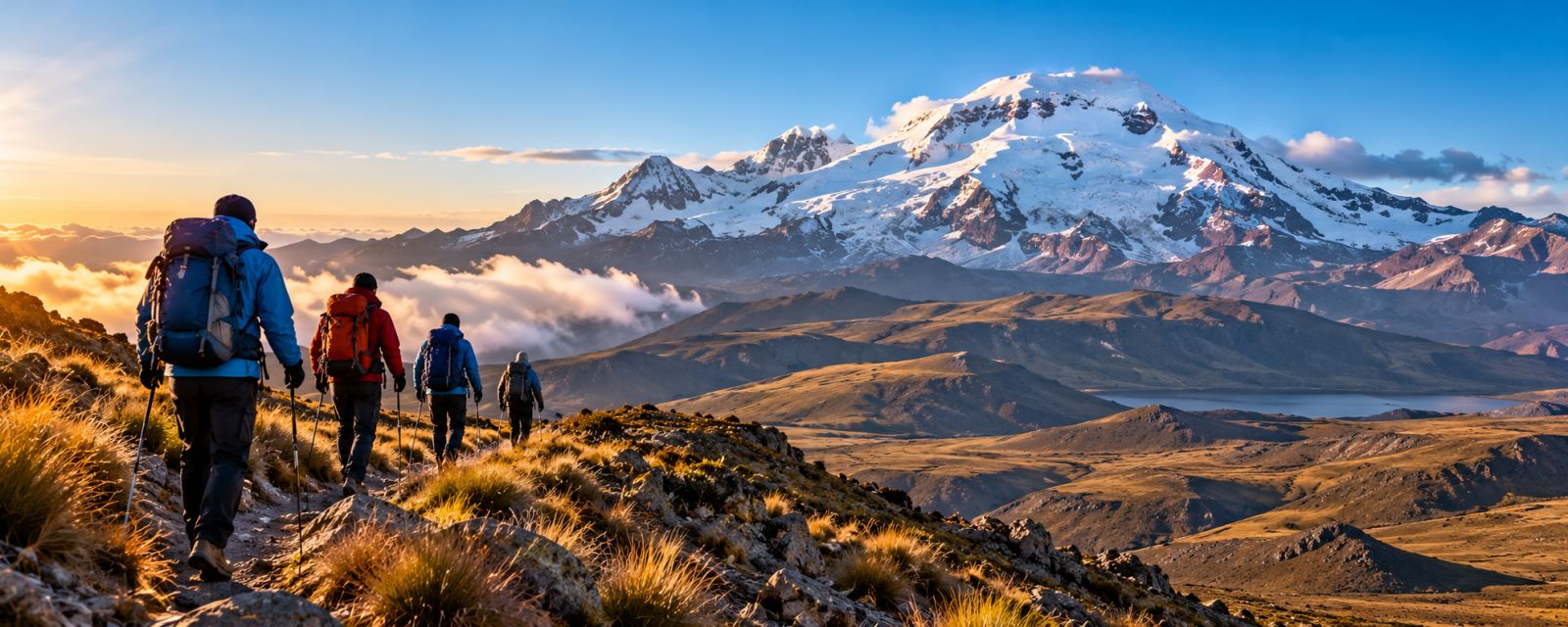
Why You Should Not Start Your Ecuador Mountaineering Trip at Chimborazo
Why You Should Not Start Your Ecuador Mountaineering Trip at Chimborazo
Climbing Chimborazo is one of the greatest mountaineering adventures in Ecuador. But if you are arriving from sea level or have not recently acclimatized to high altitude, attempting Ecuador's highest mountain at the beginning of your trip can be a serious mistake.
Standing at approximately 6,263 meters (20,548 feet) above sea level, Chimborazo is a spectacular glacier-covered volcano and one of the most challenging high-altitude climbing destinations in the Ecuadorian Andes.
Its summit is also famous for being the point on Earth's surface farthest from Earth's center, making it a remarkable objective for mountaineers from around the world.
However, Chimborazo is not a mountain that should be approached without adequate preparation.
Even experienced climbers can struggle with the effects of altitude, physical exhaustion, cold temperatures, and demanding glacier terrain.
At Ecuadorian Alpine Institute, we believe that a rewarding mountaineering adventure begins with understanding the mountain environment and preparing appropriately for the challenges ahead.
In this guide, we explain why most travelers should not begin their Ecuador mountaineering trip with Chimborazo, how acclimatization works, and which mountains can help prepare climbers for this extraordinary Andean summit.
What Makes Chimborazo One of Ecuador's Most Demanding Mountains?
Chimborazo is the highest mountain in Ecuador and one of the country's most iconic mountaineering destinations.
Located in the central Ecuadorian Andes, this massive stratovolcano rises above the surrounding highlands with extensive glaciated terrain and several prominent summits.
A Chimborazo climbing expedition may involve:
- Altitudes exceeding 6,000 meters.
- Reduced oxygen availability.
- Long and physically demanding summit attempts.
- Freezing temperatures and strong winds.
- Glacier travel and crevasse hazards.
- Steep snow and ice slopes.
- Technical mountaineering equipment.
- Changing mountain and weather conditions.
Although the technical difficulty varies according to the route and current conditions, the combination of extreme altitude and physical exertion makes Chimborazo a serious mountaineering objective.
The mountain's altitude is one of the main reasons climbers should prepare progressively rather than attempt the summit immediately after arriving in Ecuador.
1. Your Body Needs Time to Adapt to High Altitude
One of the most important reasons not to begin your Ecuador climbing adventure with Chimborazo is the need for altitude acclimatization.
As elevation increases, atmospheric pressure decreases.
Although the percentage of oxygen in the atmosphere remains approximately constant, lower atmospheric pressure reduces the amount of oxygen available to the body with each breath.
This makes physical activity more demanding and can affect normal physiological functions.
What Happens During Acclimatization?
Altitude acclimatization is the process through which the body gradually adapts to reduced oxygen availability.
These adaptations include:
- Increased breathing.
- Changes in heart rate and circulation.
- Adjustments in fluid balance.
- Increased red blood cell production over time.
- Improved tolerance to physical activity at elevation.
However, these changes do not happen instantly.
Some begin within hours, while others require days or weeks.
For travelers arriving from sea level, immediately attempting a mountain above 6,000 meters can expose the body to a significant altitude challenge before sufficient adaptation has occurred.
Good physical fitness does not replace proper altitude acclimatization.
Even highly trained athletes can develop altitude sickness if they ascend too quickly.
2. Starting at Chimborazo Increases the Risk of Altitude Sickness
Acute mountain sickness (AMS) is one of the most common altitude-related concerns for travelers ascending rapidly to high elevations.
Symptoms may include:
- Headaches.
- Nausea or vomiting.
- Dizziness.
- Loss of appetite.
- Unusual fatigue.
- Difficulty sleeping.
In more serious cases, altitude exposure can contribute to high-altitude pulmonary edema (HAPE) or high-altitude cerebral edema (HACE).
These conditions can become life-threatening and require urgent medical attention.
Why Rapid Ascent Is Dangerous
Travelers who ascend too quickly may not give their bodies enough time to adapt.
The risk depends on several factors, including the rate of ascent, sleeping altitude, previous acclimatization, and individual susceptibility.
Attempting Chimborazo shortly after arriving from sea level may therefore increase the risk of altitude-related illness.
Climbers experiencing symptoms of acute mountain sickness should not ascend to a higher sleeping altitude.
Worsening symptoms require descent and appropriate medical evaluation.
Severe symptoms, such as confusion, difficulty walking normally, or breathlessness at rest, require immediate descent and emergency medical care.
Acclimatization reduces risk but cannot eliminate it completely.
3. Chimborazo Requires More Than Physical Fitness
Many travelers believe that being physically fit is enough to climb a high-altitude mountain.
While endurance and strength are important, high-altitude mountaineering involves additional challenges.
A climber who regularly runs marathons or completes demanding hikes at sea level may still struggle at elevations above 5,000 meters.
This is because cardiovascular fitness and altitude acclimatization are different physiological processes.
Physical conditioning helps climbers manage:
- Long periods of uphill movement.
- Steep mountain terrain.
- Carrying technical equipment.
- Cold-weather exertion.
- Sustained physical effort.
However, it does not prevent altitude sickness.
Before attempting Chimborazo, climbers should combine appropriate fitness with gradual altitude exposure and relevant technical preparation.
4. Ecuador Offers Excellent Mountains for Progressive Acclimatization
One of the greatest advantages of mountaineering in Ecuador is the concentration of high-altitude mountains within relatively accessible distances from Quito.
Instead of attempting Chimborazo immediately, travelers can explore several mountains that provide opportunities for progressive altitude exposure.
Pasochoa Volcano – 4,200 m
Pasochoa is a popular high-altitude hiking destination near Quito.
Its trails offer opportunities to experience Ecuador's Andean landscapes and begin adapting to higher elevations.
For visitors arriving from sea level, Pasochoa should be considered only after appropriate initial altitude adjustment.
Rucu Pichincha – 4,696 m
Rucu Pichincha is one of the most accessible high-altitude hiking objectives near Quito.
Its proximity to the capital makes it a popular destination for climbers preparing for higher mountain adventures.
The hike provides an opportunity to assess physical performance and experience the effects of altitude.
Iliniza Norte – 5,126 m
Iliniza Norte offers a more demanding mountaineering experience.
Its rocky terrain and elevation above 5,000 meters make it an attractive objective for suitably prepared climbers.
Depending on conditions, the ascent may require scrambling skills and appropriate mountain equipment.
Cotopaxi Volcano – 5,897 m
Cotopaxi is one of Ecuador's most famous glacier-covered volcanoes.
For adequately acclimatized and technically prepared climbers, it may form part of a broader Ecuador mountaineering expedition.
Cotopaxi offers opportunities to practice glacier travel, crampon techniques, and other essential mountaineering skills.
However, Cotopaxi is itself a demanding high-altitude climb and should never be treated as a simple acclimatization hike.
Climbing Cotopaxi is not mandatory before attempting Chimborazo.
The best progression depends on individual readiness, altitude history, mountain conditions, and the expedition itinerary.
5. Progressive Climbing Helps Build Technical Confidence
Chimborazo is not simply a high-altitude hiking destination.
Its glacier-covered terrain requires specialized equipment and technical mountaineering knowledge.
Depending on the route and conditions, climbers may need to use:
- Crampons.
- Ice axes.
- Climbing harnesses.
- Helmets.
- Ropes.
- Insulated mountaineering boots.
- Appropriate cold-weather clothing.
Before attempting Chimborazo, climbers should be familiar with essential glacier-climbing procedures.
Important Skills to Practice
Crampon Techniques: Learning to walk efficiently on snow and ice while maintaining balance and traction.
Ice Axe Handling: Understanding correct ice axe use and practicing appropriate self-arrest techniques.
Roped Glacier Travel: Learning basic rope-team procedures and safe movement practices in crevassed terrain.
Mountain Communication: Following guide instructions and communicating fatigue, discomfort, or safety concerns.
Hazard Awareness: Recognizing changing snow conditions, exposed terrain, and other mountain hazards.
These skills should be developed through appropriate instruction and supervised practice.
Training improves preparedness but does not eliminate the risks of glacier climbing.
6. Starting with Easier Mountains Helps You Understand Your Limits
Every climber responds differently to high altitude.
Some people adapt relatively quickly, while others experience symptoms despite being physically fit.
Progressive mountain activities provide opportunities to observe how the body responds to increasing elevations.
During acclimatization hikes, climbers can evaluate:
- Breathing and exertion.
- Fatigue levels.
- Recovery after physical activity.
- Appetite and sleep quality.
- Headaches or other altitude-related symptoms.
- Comfort with mountain terrain and equipment.
These observations can help inform decisions about future climbing objectives.
However, successfully completing a lower mountain does not guarantee that a climber will tolerate Chimborazo's summit altitude.
Altitude-related risks must continue to be assessed throughout the expedition.
7. A Longer Ecuador Mountaineering Itinerary Can Offer Important Advantages
For international travelers arriving from low elevations, a multi-day mountaineering program can provide more opportunities for appropriate preparation.
Compared with attempting Chimborazo immediately, a longer itinerary may include:
- Progressive acclimatization hikes.
- Gradual increases in altitude exposure.
- Technical glacier training.
- Rest and recovery periods.
- Additional mountain objectives.
- Greater flexibility for weather changes.
- Time to evaluate individual readiness.
Many Ecuador climbing itineraries are organized over approximately 10–16 days or longer, depending on the objectives and climber experience.
However, there is no universally safe number of days for every person.
A well-designed itinerary should consider the sleeping-altitude profile, previous acclimatization, individual health, and actual mountain conditions.
A longer expedition is beneficial only when the additional time is used appropriately.
8. Example of a Progressive Ecuador Mountaineering Itinerary Before Chimborazo
A structured itinerary can help travelers gradually prepare for more demanding high-altitude objectives.
The following example illustrates a possible progression, rather than a fixed schedule.
Stage 1 – Arrival and Initial Altitude Adjustment in Quito
Quito is located at approximately 2,850 meters above sea level.
Travelers arriving from sea level should allow appropriate time to adjust before undertaking demanding high-altitude activities.
Light sightseeing and rest may be suitable during this initial period.
Stage 2 – Progressive Acclimatization Hikes
Once adequately adjusted, climbers may explore suitable high-altitude hiking routes such as Pasochoa or Rucu Pichincha.
These activities can provide additional altitude exposure while allowing climbers to evaluate their physical response.
Stage 3 – Higher Mountain Objectives
Depending on previous experience and acclimatization, climbers may consider a more demanding mountain such as Iliniza Norte.
The objective is to gain relevant altitude and terrain experience without progressing too quickly.
Stage 4 – Glacier Training and Advanced Preparation
Before attempting Chimborazo, climbers should review essential glacier-climbing techniques.
Technical training may include crampon use, ice axe handling, rope-team procedures, and hazard awareness.
Stage 5 – Rest and Chimborazo Expedition Preparation
Adequate recovery is important before a demanding summit attempt.
Guides and climbers should evaluate weather, route conditions, equipment, acclimatization, and physical readiness.
Stage 6 – Chimborazo Summit Attempt
A Chimborazo summit attempt should proceed only when the climber is appropriately prepared and mountain conditions are suitable.
The decision to continue or turn back must prioritize safety.
This illustrative progression requires individual adaptation. It does not prescribe specific sleeping elevations or guarantee adequate acclimatization.
9. Why Rest and Recovery Matter Before Chimborazo
Mountaineering involves sustained physical effort, especially when several high-altitude objectives are completed during one expedition.
Fatigue can accumulate from:
- Long hiking days.
- Cold temperatures.
- Carrying equipment.
- Poor sleep.
- Repeated physical exertion.
- High-altitude exposure.
Adequate rest helps climbers recover before attempting a demanding summit.
A well-organized Ecuador mountaineering itinerary should include suitable opportunities for recovery.
These may involve lighter activities, adequate sleep, nutrition, and adjustments based on individual readiness.
However, rest alone cannot compensate for insufficient acclimatization.
Both factors must be considered when preparing for Chimborazo.
10. Mountain Weather and Glacier Conditions Can Change Your Plans
Even a well-acclimatized climber may be unable to attempt Chimborazo because of unfavorable conditions.
Mountain weather can change rapidly, bringing strong winds, snowfall, low visibility, and extreme cold.
Glacier conditions may also present hazards, including crevasses, unstable snow bridges, and changes in route accessibility.
These factors can affect expedition planning.
Professional mountain preparation should include:
- Monitoring weather forecasts.
- Evaluating current route conditions.
- Reviewing glacier hazards.
- Preparing alternative plans.
- Understanding emergency procedures.
- Accepting that summit attempts may be postponed or canceled.
No mountaineering itinerary can guarantee favorable conditions or summit success.
11. Can Experienced Climbers Start Their Ecuador Trip with Chimborazo
Not every climber arrives in Ecuador with the same altitude experience.
A mountaineer who has recently spent considerable time at high elevations may already have some degree of acclimatization.
For such individuals, the appropriate itinerary may differ from that of someone arriving directly from sea level.
However, previous climbing experience alone does not guarantee current acclimatization.
The body's altitude adaptations diminish after returning to lower elevations.
Even experienced climbers should evaluate their recent altitude exposure, current physical condition, technical readiness, and the mountain's actual conditions.
For most travelers arriving without recent high-altitude acclimatization, beginning directly with Chimborazo is not advisable.
12. Why Professional Mountain Guidance Matters
Chimborazo is a demanding high-altitude mountaineering objective involving significant environmental and technical hazards.
Qualified mountain guides provide valuable experience in evaluating routes, glacier conditions, weather, and expedition logistics.
Professional guidance can help climbers:
- Understand the demands of the mountain.
- Review technical equipment.
- Practice relevant climbing procedures.
- Recognize mountain hazards.
- Make informed decisions during the expedition.
- Adjust plans when conditions change.
Travelers should verify guide qualifications, current access requirements, emergency arrangements, and the services included before booking.
Professional guidance supports better preparation but cannot guarantee safety or summit success.
13. How Ecuadorian Alpine Institute Helps Travelers Prepare for Chimborazo
At Ecuadorian Alpine Institute, we believe that reaching Ecuador's highest mountains begins with thoughtful preparation and realistic expectations.
Chimborazo is an extraordinary mountaineering objective, but its altitude and technical demands require respect.
Our Ecuador climbing adventures emphasize the importance of progressive altitude exposure, appropriate mountaineering preparation, and informed mountain decision-making.
For travelers interested in climbing Chimborazo, selecting a suitable itinerary is an important first step.
Depending on experience and available time, preparation may involve acclimatization hikes, technical training, and other mountain objectives before attempting Ecuador's highest summit.
Our team can help travelers explore expedition options that align with their climbing goals and previous experience.
Final Thoughts: Prepare for Chimborazo Before Attempting the Summit
Chimborazo is one of Ecuador's most extraordinary climbing destinations, but it should not be the first high-altitude objective for travelers who have not adequately acclimatized.
Beginning your Ecuador mountaineering adventure with progressive mountain activities can provide valuable opportunities to adapt to altitude, develop technical skills, and understand your physical response.
Mountains such as Pasochoa, Rucu Pichincha, and Iliniza Norte may form part of a carefully planned preparation program.
For suitably experienced and acclimatized climbers, Cotopaxi may also be considered as a separate climbing objective.
Ultimately, the best route to Chimborazo begins with an itinerary designed around your individual readiness.
Ready to Climb Chimborazo in Ecuador?
Discover Ecuador's highest mountain with Ecuadorian Alpine Institute.Explore guided Chimborazo climbing expeditions, acclimatization programs, and mountaineering adventures in the Ecuadorian Andes.
Whether you are preparing for your first 6,000-meter summit or planning your next major Andean climbing challenge, our team can help you explore suitable expedition options.
Contact Ecuadorian Alpine Institute today and start planning your Chimborazo mountaineering adventure.
---
Frequently Asked Questions About Climbing Chimborazo
Can I climb Chimborazo immediately after arriving in Ecuador?
Climbing Chimborazo immediately after arriving from sea level is strongly discouraged because of the altitude-related risks. Climbers should first establish adequate acclimatization and technical readiness.
How long should I acclimatize before climbing Chimborazo?
There is no single schedule suitable for everyone. The necessary preparation depends on recent altitude exposure, individual response, sleeping-altitude progression, and the expedition itinerary.
What mountains should I climb before Chimborazo?
Popular preparation objectives include Pasochoa, Rucu Pichincha, and Iliniza Norte. Cotopaxi may also be included for appropriately prepared climbers, although it is not a mandatory prerequisite.
Is Chimborazo harder than Cotopaxi?
Chimborazo reaches a higher elevation than Cotopaxi and generally presents greater altitude-related demands. Overall climbing difficulty also depends on route conditions, weather, glacier hazards, and individual experience.
Can beginners climb Chimborazo?
Chimborazo is a demanding high-altitude glacier climb. Beginners should first develop appropriate mountaineering skills, physical conditioning, and altitude experience before attempting it.
Does being physically fit prevent altitude sickness?
No. Physical fitness does not prevent altitude sickness. Even highly trained athletes require adequate acclimatization.
What is the altitude of Chimborazo?
Chimborazo reaches approximately 6,263 meters (20,548 feet) above sea level, making it Ecuador's highest mountain.
Is a professional guide recommended for Chimborazo?
Yes. Given the altitude, glacier terrain, and objective hazards, qualified mountain guidance is strongly recommended. Climbers should also verify current access regulations and requirements before their expedition.
Climbing Chimborazo is one of the greatest mountaineering adventures in Ecuador. But if you are arriving from sea level or have not recently acclimatized to high altitude, attempting Ecuador's highest mountain at the beginning of your trip can be a serious mistake.
Standing at approximately 6,263 meters (20,548 feet) above sea level, Chimborazo is a spectacular glacier-covered volcano and one of the most challenging high-altitude climbing destinations in the Ecuadorian Andes.
Its summit is also famous for being the point on Earth's surface farthest from Earth's center, making it a remarkable objective for mountaineers from around the world.
However, Chimborazo is not a mountain that should be approached without adequate preparation.
Even experienced climbers can struggle with the effects of altitude, physical exhaustion, cold temperatures, and demanding glacier terrain.
At Ecuadorian Alpine Institute, we believe that a rewarding mountaineering adventure begins with understanding the mountain environment and preparing appropriately for the challenges ahead.
In this guide, we explain why most travelers should not begin their Ecuador mountaineering trip with Chimborazo, how acclimatization works, and which mountains can help prepare climbers for this extraordinary Andean summit.
What Makes Chimborazo One of Ecuador's Most Demanding Mountains?
Chimborazo is the highest mountain in Ecuador and one of the country's most iconic mountaineering destinations.
Located in the central Ecuadorian Andes, this massive stratovolcano rises above the surrounding highlands with extensive glaciated terrain and several prominent summits.
A Chimborazo climbing expedition may involve:
- Altitudes exceeding 6,000 meters.
- Reduced oxygen availability.
- Long and physically demanding summit attempts.
- Freezing temperatures and strong winds.
- Glacier travel and crevasse hazards.
- Steep snow and ice slopes.
- Technical mountaineering equipment.
- Changing mountain and weather conditions.
Although the technical difficulty varies according to the route and current conditions, the combination of extreme altitude and physical exertion makes Chimborazo a serious mountaineering objective.
The mountain's altitude is one of the main reasons climbers should prepare progressively rather than attempt the summit immediately after arriving in Ecuador.
1. Your Body Needs Time to Adapt to High Altitude
One of the most important reasons not to begin your Ecuador climbing adventure with Chimborazo is the need for altitude acclimatization.
As elevation increases, atmospheric pressure decreases.
Although the percentage of oxygen in the atmosphere remains approximately constant, lower atmospheric pressure reduces the amount of oxygen available to the body with each breath.
This makes physical activity more demanding and can affect normal physiological functions.
What Happens During Acclimatization?
Altitude acclimatization is the process through which the body gradually adapts to reduced oxygen availability.
These adaptations include:
- Increased breathing.
- Changes in heart rate and circulation.
- Adjustments in fluid balance.
- Increased red blood cell production over time.
- Improved tolerance to physical activity at elevation.
However, these changes do not happen instantly.
Some begin within hours, while others require days or weeks.
For travelers arriving from sea level, immediately attempting a mountain above 6,000 meters can expose the body to a significant altitude challenge before sufficient adaptation has occurred.
Good physical fitness does not replace proper altitude acclimatization.
Even highly trained athletes can develop altitude sickness if they ascend too quickly.
2. Starting at Chimborazo Increases the Risk of Altitude Sickness
Acute mountain sickness (AMS) is one of the most common altitude-related concerns for travelers ascending rapidly to high elevations.
Symptoms may include:
- Headaches.
- Nausea or vomiting.
- Dizziness.
- Loss of appetite.
- Unusual fatigue.
- Difficulty sleeping.
In more serious cases, altitude exposure can contribute to high-altitude pulmonary edema (HAPE) or high-altitude cerebral edema (HACE).
These conditions can become life-threatening and require urgent medical attention.
Why Rapid Ascent Is Dangerous
Travelers who ascend too quickly may not give their bodies enough time to adapt.
The risk depends on several factors, including the rate of ascent, sleeping altitude, previous acclimatization, and individual susceptibility.
Attempting Chimborazo shortly after arriving from sea level may therefore increase the risk of altitude-related illness.
Climbers experiencing symptoms of acute mountain sickness should not ascend to a higher sleeping altitude.
Worsening symptoms require descent and appropriate medical evaluation.
Severe symptoms, such as confusion, difficulty walking normally, or breathlessness at rest, require immediate descent and emergency medical care.
Acclimatization reduces risk but cannot eliminate it completely.
3. Chimborazo Requires More Than Physical Fitness
Many travelers believe that being physically fit is enough to climb a high-altitude mountain.
While endurance and strength are important, high-altitude mountaineering involves additional challenges.
A climber who regularly runs marathons or completes demanding hikes at sea level may still struggle at elevations above 5,000 meters.
This is because cardiovascular fitness and altitude acclimatization are different physiological processes.
Physical conditioning helps climbers manage:
- Long periods of uphill movement.
- Steep mountain terrain.
- Carrying technical equipment.
- Cold-weather exertion.
- Sustained physical effort.
However, it does not prevent altitude sickness.
Before attempting Chimborazo, climbers should combine appropriate fitness with gradual altitude exposure and relevant technical preparation.
4. Ecuador Offers Excellent Mountains for Progressive Acclimatization
One of the greatest advantages of mountaineering in Ecuador is the concentration of high-altitude mountains within relatively accessible distances from Quito.
Instead of attempting Chimborazo immediately, travelers can explore several mountains that provide opportunities for progressive altitude exposure.
Pasochoa Volcano – 4,200 m
Pasochoa is a popular high-altitude hiking destination near Quito.
Its trails offer opportunities to experience Ecuador's Andean landscapes and begin adapting to higher elevations.
For visitors arriving from sea level, Pasochoa should be considered only after appropriate initial altitude adjustment.
Rucu Pichincha – 4,696 m
Rucu Pichincha is one of the most accessible high-altitude hiking objectives near Quito.
Its proximity to the capital makes it a popular destination for climbers preparing for higher mountain adventures.
The hike provides an opportunity to assess physical performance and experience the effects of altitude.
Iliniza Norte – 5,126 m
Iliniza Norte offers a more demanding mountaineering experience.
Its rocky terrain and elevation above 5,000 meters make it an attractive objective for suitably prepared climbers.
Depending on conditions, the ascent may require scrambling skills and appropriate mountain equipment.
Cotopaxi Volcano – 5,897 m
Cotopaxi is one of Ecuador's most famous glacier-covered volcanoes.
For adequately acclimatized and technically prepared climbers, it may form part of a broader Ecuador mountaineering expedition.
Cotopaxi offers opportunities to practice glacier travel, crampon techniques, and other essential mountaineering skills.
However, Cotopaxi is itself a demanding high-altitude climb and should never be treated as a simple acclimatization hike.
Climbing Cotopaxi is not mandatory before attempting Chimborazo.
The best progression depends on individual readiness, altitude history, mountain conditions, and the expedition itinerary.
5. Progressive Climbing Helps Build Technical Confidence
Chimborazo is not simply a high-altitude hiking destination.
Its glacier-covered terrain requires specialized equipment and technical mountaineering knowledge.
Depending on the route and conditions, climbers may need to use:
- Crampons.
- Ice axes.
- Climbing harnesses.
- Helmets.
- Ropes.
- Insulated mountaineering boots.
- Appropriate cold-weather clothing.
Before attempting Chimborazo, climbers should be familiar with essential glacier-climbing procedures.
Important Skills to Practice
Crampon Techniques: Learning to walk efficiently on snow and ice while maintaining balance and traction.
Ice Axe Handling: Understanding correct ice axe use and practicing appropriate self-arrest techniques.
Roped Glacier Travel: Learning basic rope-team procedures and safe movement practices in crevassed terrain.
Mountain Communication: Following guide instructions and communicating fatigue, discomfort, or safety concerns.
Hazard Awareness: Recognizing changing snow conditions, exposed terrain, and other mountain hazards.
These skills should be developed through appropriate instruction and supervised practice.
Training improves preparedness but does not eliminate the risks of glacier climbing.
6. Starting with Easier Mountains Helps You Understand Your Limits
Every climber responds differently to high altitude.
Some people adapt relatively quickly, while others experience symptoms despite being physically fit.
Progressive mountain activities provide opportunities to observe how the body responds to increasing elevations.
During acclimatization hikes, climbers can evaluate:
- Breathing and exertion.
- Fatigue levels.
- Recovery after physical activity.
- Appetite and sleep quality.
- Headaches or other altitude-related symptoms.
- Comfort with mountain terrain and equipment.
These observations can help inform decisions about future climbing objectives.
However, successfully completing a lower mountain does not guarantee that a climber will tolerate Chimborazo's summit altitude.
Altitude-related risks must continue to be assessed throughout the expedition.
7. A Longer Ecuador Mountaineering Itinerary Can Offer Important Advantages
For international travelers arriving from low elevations, a multi-day mountaineering program can provide more opportunities for appropriate preparation.
Compared with attempting Chimborazo immediately, a longer itinerary may include:
- Progressive acclimatization hikes.
- Gradual increases in altitude exposure.
- Technical glacier training.
- Rest and recovery periods.
- Additional mountain objectives.
- Greater flexibility for weather changes.
- Time to evaluate individual readiness.
Many Ecuador climbing itineraries are organized over approximately 10–16 days or longer, depending on the objectives and climber experience.
However, there is no universally safe number of days for every person.
A well-designed itinerary should consider the sleeping-altitude profile, previous acclimatization, individual health, and actual mountain conditions.
A longer expedition is beneficial only when the additional time is used appropriately.
8. Example of a Progressive Ecuador Mountaineering Itinerary Before Chimborazo
A structured itinerary can help travelers gradually prepare for more demanding high-altitude objectives.
The following example illustrates a possible progression, rather than a fixed schedule.
Stage 1 – Arrival and Initial Altitude Adjustment in Quito
Quito is located at approximately 2,850 meters above sea level.
Travelers arriving from sea level should allow appropriate time to adjust before undertaking demanding high-altitude activities.
Light sightseeing and rest may be suitable during this initial period.
Stage 2 – Progressive Acclimatization Hikes
Once adequately adjusted, climbers may explore suitable high-altitude hiking routes such as Pasochoa or Rucu Pichincha.
These activities can provide additional altitude exposure while allowing climbers to evaluate their physical response.
Stage 3 – Higher Mountain Objectives
Depending on previous experience and acclimatization, climbers may consider a more demanding mountain such as Iliniza Norte.
The objective is to gain relevant altitude and terrain experience without progressing too quickly.
Stage 4 – Glacier Training and Advanced Preparation
Before attempting Chimborazo, climbers should review essential glacier-climbing techniques.
Technical training may include crampon use, ice axe handling, rope-team procedures, and hazard awareness.
Stage 5 – Rest and Chimborazo Expedition Preparation
Adequate recovery is important before a demanding summit attempt.
Guides and climbers should evaluate weather, route conditions, equipment, acclimatization, and physical readiness.
Stage 6 – Chimborazo Summit Attempt
A Chimborazo summit attempt should proceed only when the climber is appropriately prepared and mountain conditions are suitable.
The decision to continue or turn back must prioritize safety.
This illustrative progression requires individual adaptation. It does not prescribe specific sleeping elevations or guarantee adequate acclimatization.
9. Why Rest and Recovery Matter Before Chimborazo
Mountaineering involves sustained physical effort, especially when several high-altitude objectives are completed during one expedition.
Fatigue can accumulate from:
- Long hiking days.
- Cold temperatures.
- Carrying equipment.
- Poor sleep.
- Repeated physical exertion.
- High-altitude exposure.
Adequate rest helps climbers recover before attempting a demanding summit.
A well-organized Ecuador mountaineering itinerary should include suitable opportunities for recovery.
These may involve lighter activities, adequate sleep, nutrition, and adjustments based on individual readiness.
However, rest alone cannot compensate for insufficient acclimatization.
Both factors must be considered when preparing for Chimborazo.
10. Mountain Weather and Glacier Conditions Can Change Your Plans
Even a well-acclimatized climber may be unable to attempt Chimborazo because of unfavorable conditions.
Mountain weather can change rapidly, bringing strong winds, snowfall, low visibility, and extreme cold.
Glacier conditions may also present hazards, including crevasses, unstable snow bridges, and changes in route accessibility.
These factors can affect expedition planning.
Professional mountain preparation should include:
- Monitoring weather forecasts.
- Evaluating current route conditions.
- Reviewing glacier hazards.
- Preparing alternative plans.
- Understanding emergency procedures.
- Accepting that summit attempts may be postponed or canceled.
No mountaineering itinerary can guarantee favorable conditions or summit success.
11. Can Experienced Climbers Start Their Ecuador Trip with Chimborazo
Not every climber arrives in Ecuador with the same altitude experience.
A mountaineer who has recently spent considerable time at high elevations may already have some degree of acclimatization.
For such individuals, the appropriate itinerary may differ from that of someone arriving directly from sea level.
However, previous climbing experience alone does not guarantee current acclimatization.
The body's altitude adaptations diminish after returning to lower elevations.
Even experienced climbers should evaluate their recent altitude exposure, current physical condition, technical readiness, and the mountain's actual conditions.
For most travelers arriving without recent high-altitude acclimatization, beginning directly with Chimborazo is not advisable.
12. Why Professional Mountain Guidance Matters
Chimborazo is a demanding high-altitude mountaineering objective involving significant environmental and technical hazards.
Qualified mountain guides provide valuable experience in evaluating routes, glacier conditions, weather, and expedition logistics.
Professional guidance can help climbers:
- Understand the demands of the mountain.
- Review technical equipment.
- Practice relevant climbing procedures.
- Recognize mountain hazards.
- Make informed decisions during the expedition.
- Adjust plans when conditions change.
Travelers should verify guide qualifications, current access requirements, emergency arrangements, and the services included before booking.
Professional guidance supports better preparation but cannot guarantee safety or summit success.
13. How Ecuadorian Alpine Institute Helps Travelers Prepare for Chimborazo
At Ecuadorian Alpine Institute, we believe that reaching Ecuador's highest mountains begins with thoughtful preparation and realistic expectations.
Chimborazo is an extraordinary mountaineering objective, but its altitude and technical demands require respect.
Our Ecuador climbing adventures emphasize the importance of progressive altitude exposure, appropriate mountaineering preparation, and informed mountain decision-making.
For travelers interested in climbing Chimborazo, selecting a suitable itinerary is an important first step.
Depending on experience and available time, preparation may involve acclimatization hikes, technical training, and other mountain objectives before attempting Ecuador's highest summit.
Our team can help travelers explore expedition options that align with their climbing goals and previous experience.
Final Thoughts: Prepare for Chimborazo Before Attempting the Summit
Chimborazo is one of Ecuador's most extraordinary climbing destinations, but it should not be the first high-altitude objective for travelers who have not adequately acclimatized.
Beginning your Ecuador mountaineering adventure with progressive mountain activities can provide valuable opportunities to adapt to altitude, develop technical skills, and understand your physical response.
Mountains such as Pasochoa, Rucu Pichincha, and Iliniza Norte may form part of a carefully planned preparation program.
For suitably experienced and acclimatized climbers, Cotopaxi may also be considered as a separate climbing objective.
Ultimately, the best route to Chimborazo begins with an itinerary designed around your individual readiness.
Ready to Climb Chimborazo in Ecuador?
Discover Ecuador's highest mountain with Ecuadorian Alpine Institute.Explore guided Chimborazo climbing expeditions, acclimatization programs, and mountaineering adventures in the Ecuadorian Andes.
Whether you are preparing for your first 6,000-meter summit or planning your next major Andean climbing challenge, our team can help you explore suitable expedition options.
Contact Ecuadorian Alpine Institute today and start planning your Chimborazo mountaineering adventure.
---
Frequently Asked Questions About Climbing Chimborazo
Can I climb Chimborazo immediately after arriving in Ecuador?
Climbing Chimborazo immediately after arriving from sea level is strongly discouraged because of the altitude-related risks. Climbers should first establish adequate acclimatization and technical readiness.
How long should I acclimatize before climbing Chimborazo?
There is no single schedule suitable for everyone. The necessary preparation depends on recent altitude exposure, individual response, sleeping-altitude progression, and the expedition itinerary.
What mountains should I climb before Chimborazo?
Popular preparation objectives include Pasochoa, Rucu Pichincha, and Iliniza Norte. Cotopaxi may also be included for appropriately prepared climbers, although it is not a mandatory prerequisite.
Is Chimborazo harder than Cotopaxi?
Chimborazo reaches a higher elevation than Cotopaxi and generally presents greater altitude-related demands. Overall climbing difficulty also depends on route conditions, weather, glacier hazards, and individual experience.
Can beginners climb Chimborazo?
Chimborazo is a demanding high-altitude glacier climb. Beginners should first develop appropriate mountaineering skills, physical conditioning, and altitude experience before attempting it.
Does being physically fit prevent altitude sickness?
No. Physical fitness does not prevent altitude sickness. Even highly trained athletes require adequate acclimatization.
What is the altitude of Chimborazo?
Chimborazo reaches approximately 6,263 meters (20,548 feet) above sea level, making it Ecuador's highest mountain.
Is a professional guide recommended for Chimborazo?
Yes. Given the altitude, glacier terrain, and objective hazards, qualified mountain guidance is strongly recommended. Climbers should also verify current access regulations and requirements before their expedition.